ZHLA-75-3 Immanemque
|
ZHLA-75 Immanemque
|
|||||
|---|---|---|---|---|---|
| Heavy transport airlifter | |||||
 |
|||||
| National Origin | Zokesia | ||||
| Production History | |||||
| Designer | Cyten-Ward Industries | ||||
| Unit Cost | 400,766(√) | ||||
| Number Built | 3 | ||||
| Service History | |||||
| Used By | Zokesian Royal Air Force United States of Central Kafrica | ||||
| Aircraft Characteristics | |||||
| Dry Mass | 265,889kg | ||||
| Length | 104.0 m | ||||
| Width | 129.4 m | ||||
| Height | 23.9 m | ||||
| Propulsion | 16 x Logi Motors LM-2300 High Bypass Turbofan Engines, later 4 x CWI HB-03 High Bypass Turbofan Engines |
||||
| Maximum Velocity | 110 m/s | ||||
| Operational Range | 700 km | ||||
| Crew | Two Pilots 428-640 passenger capacity |
||||
The ZHLA-75-3 Immanemque is a strategic airlift cargo aircraft designed and produced by Cyten-Ward Industries in Zokesia.
It was originally developed during the 2150s as an enlarged derivative of the ZHLA-17 airlifter for the express purpose of transporting RHDE Main battle Tanks. On 21 December 2158, the ZHLA-75-3 performed its maiden flight; only three aircraft were ever completed. While the second airframe is still in active service, the first has had a more diverse life. After a brief period of use in the Confederate Strategic Airlift Command, the aircraft was mothballed during the early 2190s. Towards the turn of the century, it was decided to refurbish the ZHLA-75-3 and reintroduce it for commercial operations, carrying oversized payloads for the operator Confederate Air, with a clause in the contract to be re-purchased by the Confederacy in times of need.
Design
The ZHLA-75-3 was designed around a central tennant to carry 250 tons of cargo, while simultaneously able to handle large, bulky loads that most airlifters are unable to carry. Its 10m x 10m x 50m cargo hold has a floor-to-ceiling capacity of 3,700 cubic meters of cargo, enabling it to carry large helicopters, heavy machinery, or bulk fuel shipments. With a range of 700km, the Immanemque is able to also operate at rough and unprepared fields thanks to its robust landing gear array and large wing area. The maximum takeoff weight is 600,000 kg, or nearly two and a half times its unladen weight.
The second airframe, ZHLA-75-4, was built on improvements to the first that resulted in additional engines for short takeoff and landing and reduction in drag along the leading edge.
New Engine Option
In 2202, the New Engine Option upgrade for the Immanemque saw the mounting of the CWI HB-03 Turbofan engines, which increased its total thrust output to 10,304 kN of thrust. Maximum takeoff capacity increased to 800,000kg. Both ZHLA-75-3 and ZHLA-75-4 were upgraded to the New Engine Option standard by 2203.
ZHLA-75-5 was never completed during initial production. Designed to carry more heavy tonnage loads, the ZHLA-75-5 was going to include on-board cranes for moving cargo and bulkheads to separate cargo. Multiple announcements were made regarding the potential completion of the third airframe, though its construction largely remained on hold due to a lack of funding. By 2200, it had reportedly been brought up to 60–70% completion.
Export
In 2203, United States of Central Kafrica purchased the unfinished ZHLA-75-5 with the stipulation it would be completed to the ZHLA-75-4 NEO standards, removing the ambitious cargo cranes and bulkheads.
Accidents and Incidents
The Immanemque fleet has been involved in no accidents and no hull loss incidents since its inception.
See also
Aircraft of Comparable Role, Configuration, and Era
- C512 Belugaléo – Algizan/Tekkian strategic heavy lift cargo aircraft
- LC-4 Monumentus – Ikonic twin-fuselage military transport aircraft
- W-3033 Stratocruiser – Zokesian large commercial transport aircraft
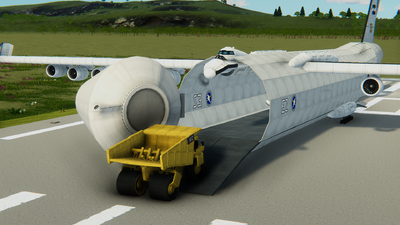
A Kolus Road Series C-4000 Dump Truck driving onto the ramp of Immanemque.
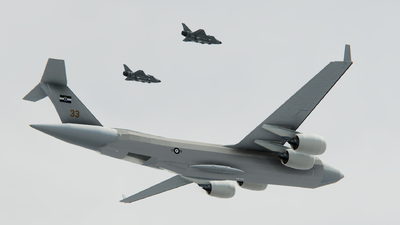
The Immanemque is at the time of construction the largest wingspan cargo aircraft ever built.
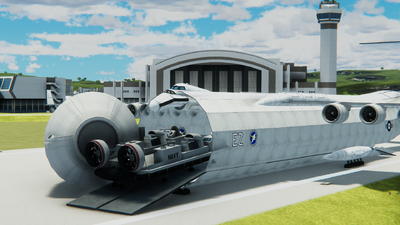
Immanemque loading a Landing Craft Air Cushion
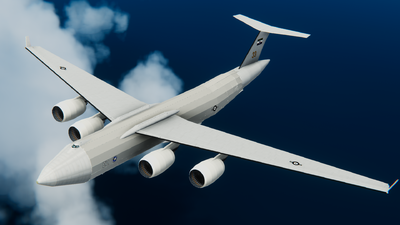
ZHLA-75-4 with the New Engine Option upgrade, 2203.
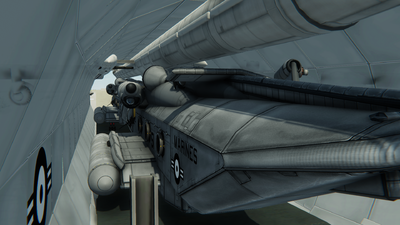
ZHLA-75-3 Immanemque carrying two ZH-53 Super Erol transport helicopters.
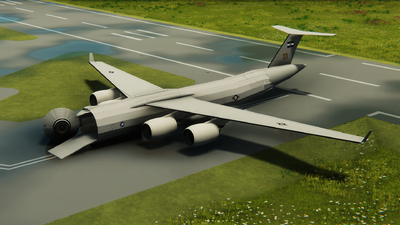
ZHLA-75-4 Immanemque with all cargo doors open.
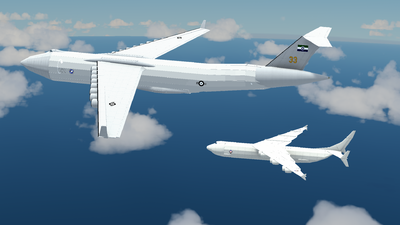
ZHLA-75-4 flying with a Nuvastian cargo aircraft.
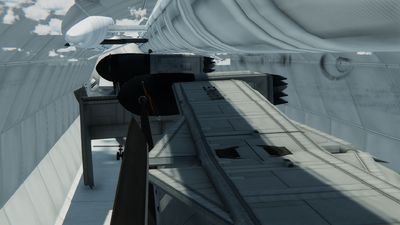
MZ-22 Albatrosses loaded on Immanemque.


